
Ambient AI
The loudest revolution in technology is happening where everyone is looking. A quieter one is happening underneath, and it may reshape more of ordinary life than any of us expect.

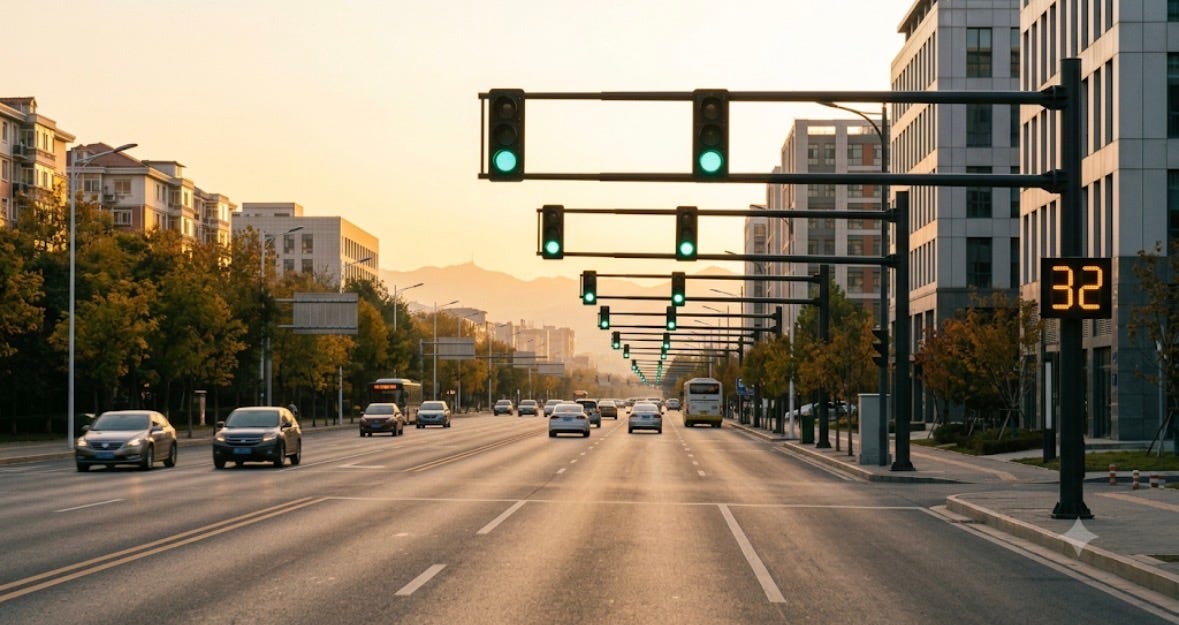
There is a road in the south of the Netherlands where the traffic lights seem to wait for you. Drive it at the right speed and each signal turns green just as you reach it, one after another, the whole corridor opening ahead of you. A small board on the roadside tells you the number to hold. Fifty-three. Nothing else. No screen full of data, no app, no alert. Just a number on a sign, and somewhere behind it a system that has already counted the cars ahead of you, measured the gaps between them, worked out the timing of every light on the route, and decided that fifty-three is the speed that makes the city dissolve quietly beneath your wheels.
I keep coming back to that road. Not because it is impressive technology, exactly. It is the opposite of impressive in any way you can point at. It is a sign with a number on it. What stays with me is the strange shape of the thing underneath, because the more I look at it the more it seems to describe something much larger that is happening all around us, mostly unseen.
Think about what that road is doing. An enormous amount of computation went into producing the smallest possible result. All of the intelligence stayed hidden, and the only thing that reached me, the person in the seat, was a single number I could choose to follow. That inversion is worth sitting with. The cleverness runs deep and out of sight, and what surfaces is almost nothing — one quiet instruction. I have started to think of this as ambient AI: intelligence dissolved into the physical world, invisible while it works, surfacing only as the simplest thing it can say to you. Not something you open or talk to. Something you move through without noticing it is there.
We have spent three years rightly transfixed by the other kind of AI, the kind that talks. The models that write and reason and code, the agents that now spin up a working website in the time it takes to describe one, the systems that seem to do something new and astonishing every few weeks. That attention is not misplaced. That really is where the most dramatic change is happening, and it is what pulled most of us into this whole subject to begin with. I am as caught by it as anyone.
But all that brightness has a way of stepping over a second thing happening at the same time. Quieter. Slower. Far less spectacular to watch. And, I have come to think, no smaller in what it will eventually mean. While we look up at the frontier, the ground beneath us is starting to change.
## The century of dumb concrete is ending
For about a hundred years, infrastructure has been a fixed thing. You poured the concrete, wired the grid, hung the traffic light, laid the rail, and from that day on it ran the same rigid program until a crew came to repair it. A traffic signal in 1970 and a traffic signal in 2020 did fundamentally the same thing. Each one counted down a timer it had been handed at installation, indifferent to whether the road in front of it was jammed solid or completely empty. The grid pushed power in one direction and hoped supply matched demand. The pumps ran on a schedule. The trains followed a timetable drawn up months in advance. None of it could see anything. None of it could think. Infrastructure was a finished object, complete the day it opened, and slowly decaying from that moment forward.
That is the part that is now ending, and it is ending faster than most people have noticed.
What is taking its place is infrastructure that behaves more like a living system. It senses its own state as things happen, works out where they are heading, decides what would be better, and acts. Then it does the whole loop again, continuously. And the thing I find genuinely striking, the thing that makes this one story rather than a dozen unrelated ones, is that it is the same loop everywhere you look. The traffic light learning to wait for you and the power grid balancing itself thousands of times a second are not two separate trends. They are the same idea.
Once you see the shape, your mind automatically starts seeing it everywhere. Here in the Netherlands, the agencies that have kept a country alive below sea level for centuries are moving to models that compute a flood scenario in seconds where the old simulations took hours, closing barriers on a forecast before the water has even begun to rise. The same loop is quietly turning up in the rail network routing its own trains, in the port reading tides and currents to slot a ship into a waiting berth, in the district heating that warms a whole city by weighing tomorrow's weather against today's demand. The engineers who built that last one describe their goal as doing all of it without the residents ever noticing, and that phrase has stayed with me, because it is really the whole spirit of the thing. The highest compliment this kind of intelligence can earn is that you forget it was ever there.
The biggest challenge in that loop shows up most clearly in electricity. The data centres behind the loud AI are consuming power at a pace that is bending the grid out of shape. You cannot answer that with new power stations alone. So instead, the grid is being taught to think. Hundreds of thousands of home batteries and water heaters and thermostats are being woven together into what amounts to a single power plant with no chimney, one that exists only as coordination, that an algorithm can call on in concert at the moment it is needed. I already shared my thoughts on this back in October, when I wrote about the AI energy bottleneck and the early, mid, and end stages of that market.
It is worth pausing on what this buys, because the gains are not small. We are pulling capacity out of infrastructure we already own, simply by letting it see and decide, without pouring any new concrete at all.
And what makes this the moment, rather than some moment ten years ago, is that the thinking is getting cheaper. The cost of a given amount of AI capability has been falling, and is still falling. When the thing that makes a system smart keeps getting cheaper like that, you stop reserving it for the single most important asset and start putting it into all of them. Every light. Every pump. Every transformer. Every berth and every train. The economics that kept infrastructure dumb for a century have simply turned over.
## It arrives unevenly, and that is telling in itself
The change is happening, but of course not everywhere at once. It arrives first where the ground is soft.
You can already see what it buys where it has taken hold. When the city of Hangzhou let a system coordinate more than a thousand of its traffic signals as one network, rather than a thousand stubborn separate timers, the city fell from the fifth most congested in China to the fifty-seventh. Ambulances began reaching emergencies in roughly half the time they used to, and the pressure came off the roads without a single new lane being laid. Nothing was built to achieve it. The same city, suddenly able to think.
In the Gulf, they are trying something bolder still, skipping the slow retrofit entirely and building cognitive cities up out of bare desert, with the coordination designed in from the first drawing rather than bolted on later. Whether the most extravagant versions of that vision ever get fully built is a fair question. But the approach itself, starting from nothing with no legacy to tear out, is the fastest path there is, and it shows you the shape of what a city built to be orchestrated wants to become.
The change moves fastest where decisions are centralised, where the build is new, where a society is comfortable letting a system act on its behalf. The places best suited to deploy it quickly are not always the same places that invented the pieces.
## A day inside the quieter world
Let me try to describe an ordinary morning a few years out. To really understand the size of it, you want to visualise it.
You wake in a home that has been quietly managing itself through the night. The heat pump did most of its work in the small hours, when the wind was strong and power was nearly free, banking warmth in the mass of the building so that the morning costs almost nothing. You never touched a thermostat. You never thought about any of it. The house optimised itself around you while you slept, and the only trace of it is a room that happens to be exactly the right temperature and a bill that is smaller than it has any right to be.
You get into the car, and the route that loads is not the shortest one, and not even the fastest one taken on its own. It is the route the network has chosen for you knowing where every other car leaving right now is also trying to go, so that all of you move better together than any of you could alone. You reach the corridor and the lights open ahead of you in sequence. Fifty-three again. The city dissolves. Somewhere a system has folded your single trip into the movement of ten thousand others and found the arrangement in which nobody has to fight anyone, and none of that reaches you. What reaches you is only that the drive was easy.
The car a little way ahead is an ambulance, and three intersections before it arrives the lights have already cleared its path, because the network saw it coming and bent the city gently around it. Minutes saved. Now and then, a life.
Your car charges itself in the early afternoon instead of the evening, not because you scheduled it but because the grid asked, offering a few cents and a cleaner conscience to move your demand to the hour when the sun is highest, and the car simply accepted on your behalf. Multiply that small unseen agreement by a million cars and you have flattened a curve that used to require a fleet of gas plants standing ready. The plants that never had to be built are, in a way, the most elegant infrastructure of all. They exist only as an absence, as something quietly made unnecessary.
And below all of it, out of sight, the heavy machinery of the world is breathing in the same rhythm. The water network reroutes around a building pressure spike before it becomes a burst main in the street. A port two hundred kilometres away slots an arriving ship into a berth that opens at exactly the hour it is needed, so the ship never sits idling offshore burning fuel. A freight train you will never ride finds a path through the network that appeared on no timetable. None of this asks for your attention, and that is exactly the point.
This is the texture of the world that is coming. Friction quietly dissolving in a thousand small places at once. Every wait at a red light, every spike in a bill, every flooded underpass, every ship idling outside a crowded port is, when you look closely, a coordination failure, a place where infrastructure that could not see far enough simply failed to arrange things well. And one by one, those places are starting to be seen. The remarkable part is how little of it you will ever perceive. The intelligence makes its progress precisely by disappearing. You will not marvel at it. You will just notice, on some unremarkable Tuesday, that the day put up a little less resistance than it used to.
That is the thing I cannot stop turning over. After a century of building infrastructure that could only ever decay from the day we finished it, we are starting to build infrastructure that gets a little better every day it runs. It does not announce itself. It will never trend. And it may quietly touch more of ordinary life than the louder revolution we are all, quite reasonably, watching instead.
Which brings me to the part that is harder to see from the outside, and worth saying plainly.
When you visualise this world and think about where the value is captured, the instinct is to look at the intelligence itself, the brains of the thing.
A part of the value seems to settle somewhere far less glamorous. It settles in the layer that sits on top of all the messy physical hardware, the pipes and poles and meters and controllers, the layer that the intelligence has to run through in order to touch the real world at all. To own that layer you have to own the unglamorous part, the integration into thousands of municipal contracts and utility certifications and regulatory approvals, the slow grinding work no clever model can simply leap over. The intelligence has become the easy part. Being the thing the intelligence has to plug into, the part that is certified and embedded and depended upon and paid month after month, is the hard part, and the hard part is where the value protects itself.
It is worth being concrete about how this works, because there is a quiet asymmetry in it. The people who own these systems, a city, a water authority, a power company, sit on the hardware and the data, but the last thing most of them want is to become a software company themselves. They would much rather someone else handled the thinking. So whoever steps in to be that thinking layer ends up in an unusual position. They become the part nobody especially wanted to own, that everybody nonetheless has to run through. And once a city's intersections or a utility's grid are breathing through your system, you do not get unplugged on a whim. You have become load-bearing.
That changes what such a company is worth, in a way that is easy to miss from the outside. It begins life selling a thing, a box, a sensor, a contract, the sort of sale that competitors copy and that prices grind steadily toward the floor. But if it becomes the layer the system genuinely runs on, it stops being paid for a product and starts being paid simply to keep things running, month after month and year after year, because the alternative is the lights going out. That is the same shift I have watched reshape other corners of technology, where something that was sold as a cheap commodity quietly turns into something priced like infrastructure, like a bridge or a power station. When that turn happens to a company, its position does not just improve. It changes category.
A good example to point to is Kraken, the software arm that grew up inside Britain's Octopus Energy. Over the past few years it quietly became the operating system running the billing, the grid services, the customer machinery for utilities in a long list of countries, contracted now to more than seventy million accounts and processing fifteen billion data points a day, with over half a billion dollars of contracted recurring revenue that has roughly quadrupled in three years. As it spins out toward independence in 2026 it carries a valuation close to nine billion dollars before it has even reached the public market, and its chief executive talks openly about reaching a billion lives within a decade. That is the scale this layer can reach when a company truly owns it. Not a feature sitting inside something larger, but the nervous system of an entire industry, priced like the critical infrastructure it has quietly become.
You can watch the same playbook one layer over. NoTraffic is doing to the traffic signal something close to what Kraken did to the meter, turning intersections into software it runs centrally, live now in more than four hundred agencies and pushing toward one in every ten across North America, still private and still early. Miovision is working the same intersections from a different angle. These are the companies quietly settling into the nervous-system layer of physical infrastructure before most people have a name for the category at all.
And here is the detail I find most telling. The public market keeps losing access to this layer almost as fast as it appears. The pure plays that do list tend to be bought and taken private before ordinary investors can compound alongside them. Iteris was absorbed by an Italian group. Yunex was taken for around a billion. Q-Free and Volue and others were quietly delisted, the grid-software specialists folded into larger conglomerates and private buyers. The reason is not mysterious, and it is really the same point the whole essay keeps circling. A private buyer can look at one of these companies and see clearly what it is, contracted revenue, deep switching costs, a position embedded in critical infrastructure, and can value all of that precisely. The public market, meanwhile, often still files the same company under boring industrials and declines to pay up for it. So the private buyer quietly takes it, arbitraging a gap the public has not yet woken up to. The smart, patient money is not distracted by the noise at the frontier. It is down here, buying the quiet layer, while most attention stays up where the lights are brightest.
None of this is going to be smooth, and it would be dishonest to pretend otherwise. The road from a working demonstration to a deployed system runs straight through procurement budgets and liability arguments and data-governance fights and the slow grinding politics of public institutions. And a system that acts on the world can act wrongly, with the stakes rising the moment infrastructure stops merely reporting and starts deciding. All of that is real, and all of it will slow things down.
But none of it changes the direction of travel. It only changes the timing. The cost of intelligence keeps falling, the load on our infrastructure keeps climbing, and the only real way through is to let the concrete start to think. The loud revolution is teaching machines to speak, and it deserves the attention it gets. The quieter one is teaching the world to listen to itself, and it is happening so close underneath us, so deliberately and so without spectacle, that it is easy to look straight past it on the way to something brighter. On some ordinary morning a few years from now you will move through a day that has quietly arranged itself around you, the lights opening, the power flowing, the water and the rail and the steel all breathing in a rhythm you never see. You will not notice a single line of it. That is exactly why it is being underestimated.
So let me say plainly what I have come to believe, because it is the thing I am most convinced of. There is going to be a layer in all of this that captures an enormous share of the value. It is the unglamorous operating layer that the physical world comes to depend on and cannot easily unplug, the part that gets paid simply to keep things running. That is where the durable value in ambient AI is going to settle, and I do not think it is close. Kraken is what it looks like early, near nine billion dollars before it has even gone public, on revenue that is contracted, recurring, and embedded. The traffic and grid and water versions of that company are being built right now, most of them still private, several of them being quietly bought before the public ever gets a clean look. A part of the smart money is already down here, in the plumbing, while the rest of the attention stays up at the frontier where the lights are brightest.
That is the part I would not look away from. The revolution everyone is watching is real. But the one that ends up running the world you wake into each morning may be the quiet one.