
Nebius - Strategy Masterclass
by Markos

Nebius just finished its outstanding Q2 call and earnings release. You have all seen the earnings numbers by now, So I am not going to repeat the quarter here. I want to talk about the strategy, because the most important development is not simply that Nebius is building more capacity. It is how the company is positioning itself to use that capacity.
Nebius explained three types of contracts on the call. Long-term contracts with investment-grade customers help finance the buildout. You use these for acceptable terms to fund your operations and postion yourself for the most faborable client mix. These are the 5 year AI cloud agreements with the Hyperscalers. Second you have the one-to-three year contracts you focus on with enterprise, souvereign and frontier labs against a higher price. These are companies that provide a long run way of early AI adoption and are your best target client to build a customer trust connection with and commit together to scale in the future. I call them the high potentials. And then there is a smaller pool of capacity for customers that need a very large amount of compute immediately and only for a limited time. Those customers are willing to pay a very high price for it. Lets call them burst buyers.
And the interesting part is that Nebius could already sell all of its planned 2027 capacity today on the normal one-to-three-year terms. Management is choosing not to. That decision tells you quite a lot. They are building capacity in advance, but deliberately not selling all of it in advance, because they want to keep the ability to decide later where that capacity creates the most value.
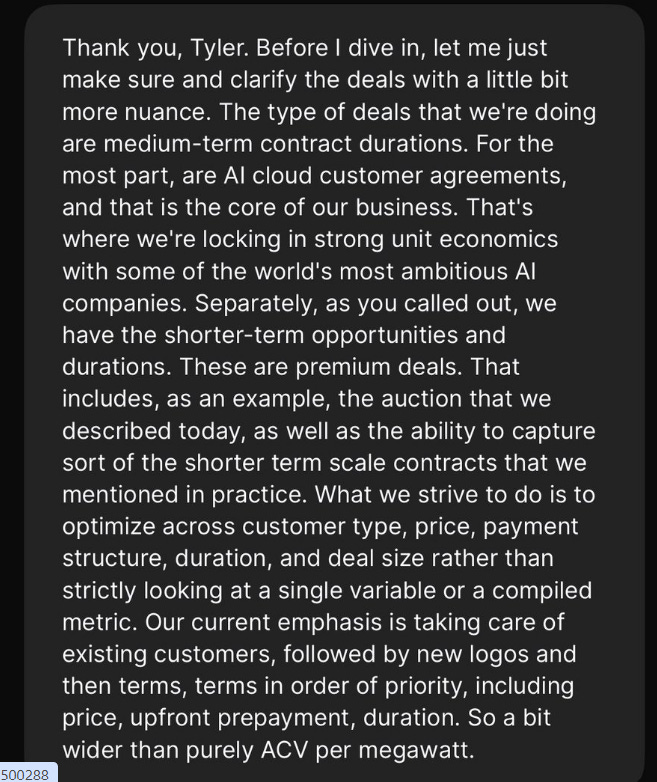
Nebius is optimizing across customer, price, prepayment, duration and deal size, not simply selling every megawatt to the highest headline bidder.
See how they have set this up? The big stable contracts finance and utilize the base. Arround 70% of the deals closed in Q2 included prepayments covering 50% to 60% of the associated CapEx. Then the high potentials serve you lock in for commited future growth as their runway is much longer and will grow in capacity hunger. The company then can then keep a smaller portion flexible and wait for opportunities that deserve a completely different price. Nebius is not optimizing one number. It is optimizing the customer, price, prepayment, duration, deal size and the possibility that the relationship becomes much bigger later. Next to be able to feed the burst buyers which has the high pricing. (The 40-50 mil per MW) I will elaborate a bit further in the article how they build that up really smart. Lets show some fundamental changes first that the market gave insight in.
pricing signal move from $12 million to above $20 million and peak above 40 mil for burst demand buyers.
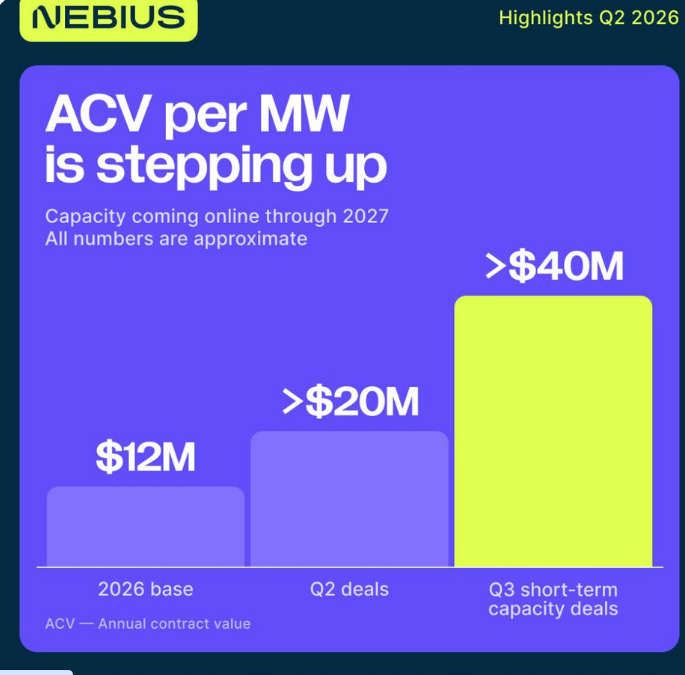
he normal Q2 deals moved above $20 million per megawatt before the short-term premium deals moved above $40 million.
The $40 million-plus short-term price gets most of the attention, but I think the move underneath it is more important for the long-term model. Nebius shows a 2026 base of about $12 million of ACV per megawatt and Q2 deals above $20 million. That is not a small pricing improvement. It means the normal contracts are moving up strongly before we even talk about auctions or customers that need capacity immediately.
I would therefore see roughly $20 million per megawatt as the first real indication of where the pricing floor for new normal deals may be settling, but not as a fixed price list. Management again was very clear that it optimizes across customer type, price, prepayment, duration and deal size. A contract at, hypothetically, $18 million per megawatt can still be the better deal if the customer prepays more CapEx, signs for longer, has a stronger credit profile or creates a much larger path into inference and future capacity. See it as a payment to optimize client mix to keep executing on that agile strategy. Agility keeps this strategy alive.
The opposite is also true. Nebius may ask above $20 million if the contract is shorter, the customer wants more flexibility, the deployment is more complex or the company gives up too much future capacity. So the strategic point is not that every new contract should be modelled at exactly $20 million. It is that the centre of gravity has moved from about $12 million to above $20 million, while Nebius now has enough demand to become more selective about which economics it accepts. Again agile strategy. In a fast moving market the agile strategy captures the best economics in my opinion. Strong base with agility on top.
That is also why I would not use a single ACV-per-megawatt number to value the whole build. Two contracts can have the same headline ACV and still be very different for Nebius. One can finance most of the hardware upfront and bring a new strategic customer onto the platform. The other can tie up scarce capacity for years without enough flexibility. The first can easily be worth more, even if its reported ACV per megawatt is slightly lower. Strategic importance vs economics is what management weighs these deals on.
This is a proven strategy troughout succesfull companies in history. A decision metric I personally used for a decade on all major deals i had to make for the company I worked for.
Do not apply the peak price to every megawatt of course. X is full of these BS headlines already.
Peak pricing is literally peak pricing for the burst buyers. You can‘t model the $40 million to $50 million per megawatt number and apply it to every gigawatt Nebius is going to build, because that is simply not in line with reality. This is annualized pricing for short-term deals that normally run for three to six months. The normal one-to-three-year contracts signed this quarter were priced at $20 million to $25 million per megawatt.
That annualized part is important. It does not mean the customer pays the full $40 million to $50 million for a three-month engagement. The actual contract value is adjusted for the shorter duration. But it does show the much higher rate Nebius can charge when the customer needs a dedicated cluster immediately, because the value sits in the timing and certainty rather than in using that capacity for a full year. It is also a leading indicator and metric on the power scarcity and online compute. You could also debate as the rising indicator for ROI on AI. that‘s a other debate.
You should see the $40 million to $50 million as premium pricing for customers that need a large amount of compute immediately and only for a limited time. Management mentioned dedicated GB300 clusters for a large training run ahead of a model release or for a reinforcement-learning post-training sprint. If a frontier lab needs a few extra weeks or months before launch, waiting for new capacity is not an option.
To break it down a bit for the more average investor: Think of it like renting a Ferrari for a wedding weekend. You pay a very high daily price compared with what you would pay to lease a Ferrari long term. But the customer does not need that Ferrari all year. They only need it for that specific moment. And for the rental company, which is Nebius in this case, the economics can be very strong if it can rent the same car repeatedly.
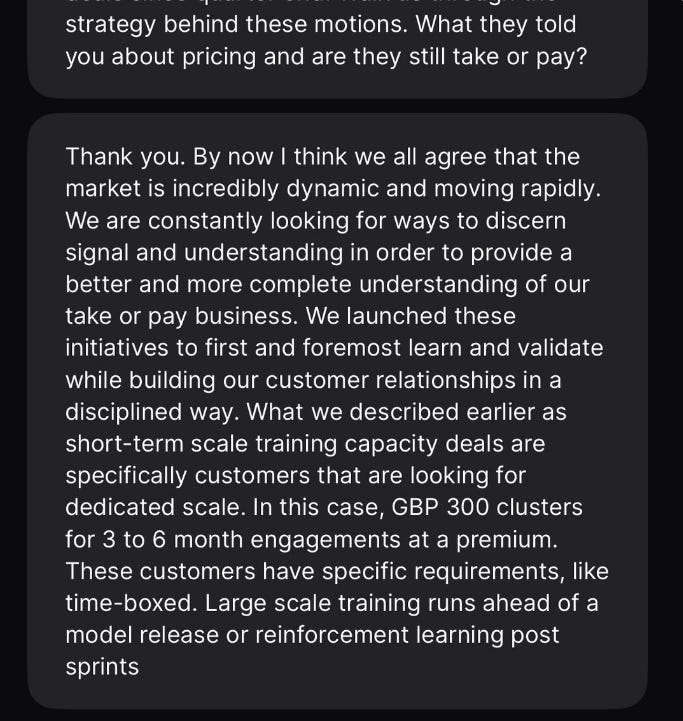
Frontier labs need immediate, time-boxed capacity for large training runs ahead of model releases and post-training sprints.
According to management this is fully aligned with how the market is developing. Even to their suprise as they said. Management was positioning on agility but sometimes you can’t see the whole playbook so this landed in their advantage. You need some luck sometimes also right? Management sees that more and more frontier labs and AI-native companies are coming online, and model launches are becoming bigger and more competitive. So the market for immediately available capacity gets bigger with them. Nebius does not need to price every megawatt this way. It needs enough urgent customers moving through a smaller flexible pool with as little idle time as possible. If it can do that, the ROI on that pool can be very high.
The auction tells Nebius what capacity is worth today
As briefly touched earlier the auction sits next to this short-term strategy, but it is not the same deal. The auction was a separate go-to-market motion for free, unallocated capacity. It cleared 15% above the highest price Nebius had charged before and 20% above its Blackwell pipeline. The winning customer was happy with both the pricing process and the certainty that the compute would actually be available, and already said it wants to participate again.
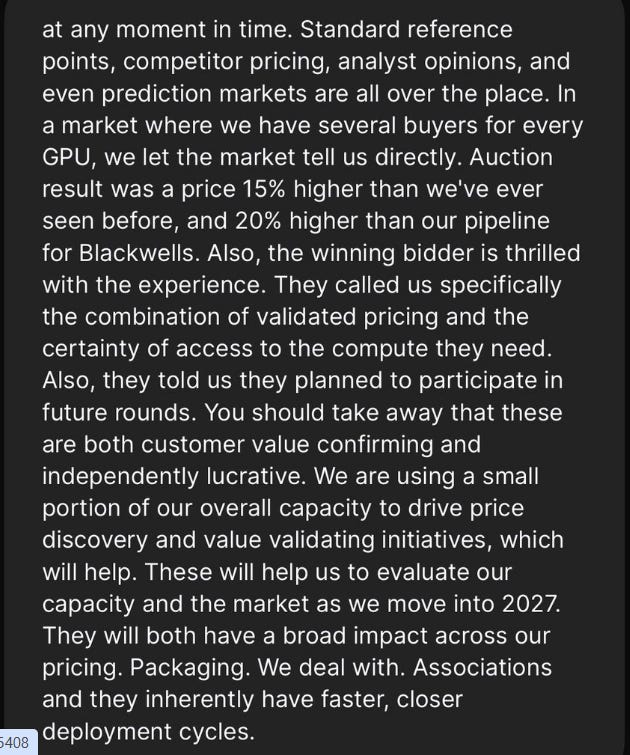
Nebius is using a small part of its capacity to let the market tell it directly what scarce compute is worth.
This is a very smart way to get actual price discovery in a market where standard reference points, competitor pricing and analyst estimates are all over the place. Nebius said there are several buyers for every GPU, so instead of guessing what the capacity is worth, it just lets the market decide it. Just let them bid.
But again, management said it is using only a small portion of the overall capacity for auctions and other price-discovery initiatives. The goal is to learn what a scarce block of capacity is worth at that exact moment, use that information in future negotiations, and keep the majority of the business on more predictable contracts. Right in the 3-lane strategy we pointed out in the start.
Build capacity in advance, but do not sell all of it in advance
Nebius adressed the model very plainly on the call: “Our model was built to build capacity in advance, but not to sell it in advance.”
In a market where prices and customer needs are changing this quickly, selling every megawatt years ahead removes your ability to react. Nebius is accepting some utilization risk in exchange for option value. Very strong strategic play by management.
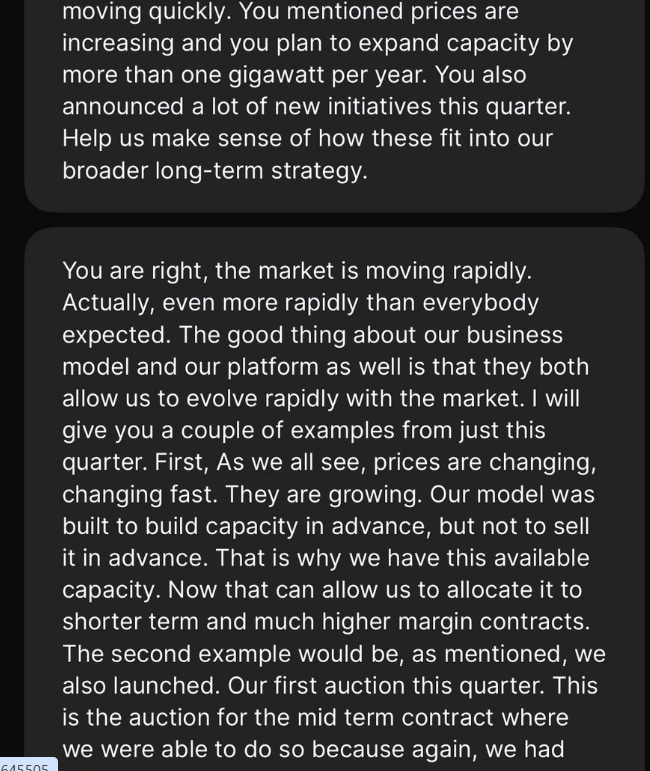
Nebius is deliberately preserving free capacity so it can react to the market instead of locking everything away years in advance.
Of course, this only works if the stable base is large enough. Unallocated capacity can also sit idle, and if pricing turns before the hardware is placed, Nebius carries that downside. But with long-term customer commitments, more than $9 billion of expected prepayments in 2026 and asset-backed against contracted cash flows, the company is trying to finance the base while keeping that smaller layer open. See the way they have balanced that? Stability underneath, agility on top.
The customer mix is also a financing strategy
This is where the three contract types come together financially. The long-term investment-grade contracts are as pointed out not there because Nebius wants to lock the whole platform away at the lowest price. They are there purely because they make the build financeable. Customer prepayments reduce the amount Nebius has to fund itself, and the contracted cash flows can then support asset-backed debt on top.
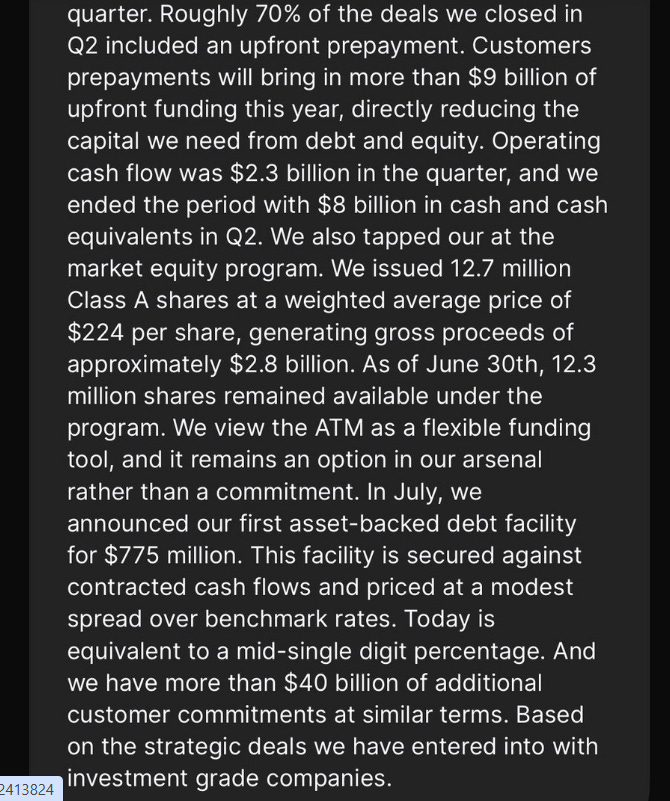
Roughly 70% of Q2 deals included prepayments, while contracted cash flows already supported Nebius’s first asset-backed debt facility.
Nebius expects more than $9 billion of customer prepayments in 2026. It also raised a $775 million facility against deployed GPU infrastructure and the contracted cash flows from an investment-grade customer, while saying it has more than $40 billion of additional customer commitments on similar terms. So every stable contract can do two jobs. It produces future revenue, but it also helps pay for the capacity before that revenue arrives.
This matters because building ahead normally creates a funding problem. You spend the money first and only find out later whether the customer arrives. Nebius is trying to solve that by financing the stable base through prepayments and contracted cash flows, while preserving some capacity that has not yet been allocated. That smaller open part can then be used for the higher-priced short-term deals, auctions or a new strategic customer that suddenly appears.
So when Nebius evaluates a customer, price is only one part of the return. The company also has to ask how much CapEx the customer funds, whether the contract supports cheaper debt, how much capacity it locks up, how strong the credit is and what that customer can become later. This is again why a slightly lower ACV can still create more value for Nebius than the highest visible price.
The third-party strategy is where it becomes really interesting
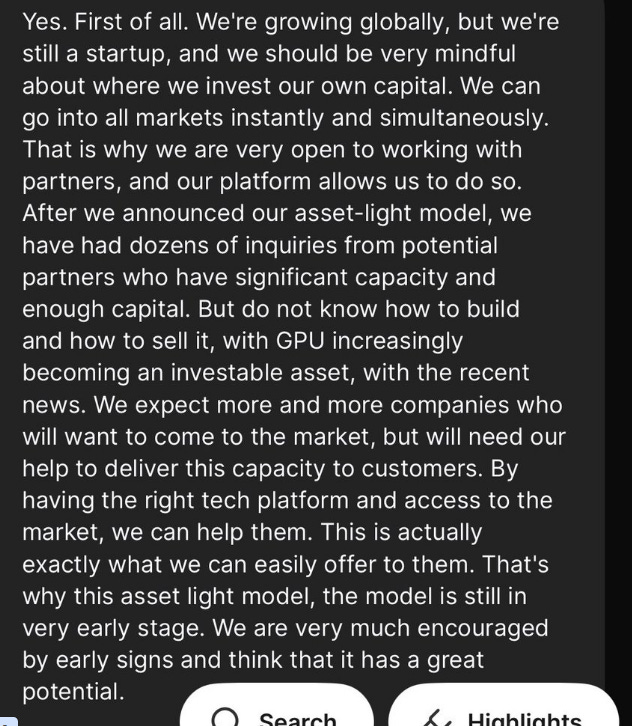
Potential partners have capacity and capital, but need Nebius to build the product and bring it to customers.
Nebius said it received dozens of inquiries from potential partners that have significant capacity and enough capital, but do not know how to build the full AI cloud product or how to sell it. This is a gap Nebius deliberatly wants to fill. The partner owns and finances the infrastructure. Nebius brings the architecture, reference design, full-stack software and access to customers.
Put more plainly, Nebius can take somebody else’s power, building and GPUs and turn them into Nebius capacity. The partner gets a much faster route into the AI cloud market. Nebius gets extra capacity on its platform without paying for the entire underlying asset itself.
And this is why the multi-tenant platform matters so much. If the same Nebius platform can run across owned data centers, colocated capacity and third-party capacity, management can treat those different sources as one broader pool. It can use long-term customers for the stable base, move the short customers through the flexible part, and add capacity from partners when the market gives it an attractive opportunity.
This is also where the Ferrari example what I pointed out before has double use. Nebius does not necessarily have to buy every Ferrari itself. A partner can own the car, while Nebius provides the platform, customer access and the learned knowledge (or monitored) of how to keep it rented. If Nebius can standardize that partner capacity and move enough short-term customers through it, it can earn on the software, operation and sale of the capacity while using much less of its own balance sheet.
And I love to give credit to Nebius here. I already wrote a while back, when discussing its partnerships, that using partners to scale a third-party multi-tenant platform would make a lot of sense. In my opinion, agility is everything in this market. Capacity takes a long time to build, while model companies can suddenly need an enormous cluster for only a few critical weeks or months. Nebius management has positioned the company between those two timelines really, really well.
It also changes the relationship between revenue growth and Nebius’s own CapEx. If all growth has to come from owned data centres, every new dollar of capacity requires another large investment from Nebius. Partner-owned capacity breaks part of that link. Nebius can still earn from running the platform, selling the capacity and adding software and services, while the partner funds more of the power, building and hardware underneath it.
That does not mean the economics will automatically be better. Nebius has to share part of the return with the partner, standardize different sites and prove that third-party capacity performs as reliably as its own. But if it works, the company can enter more regions, react faster and grow the platform without putting the same amount of balance-sheet capital behind every megawatt. That is why management calls it asset-light, and why the model can become much more important than a normal capacity partnership.
The short-term deal can become a long-term customer
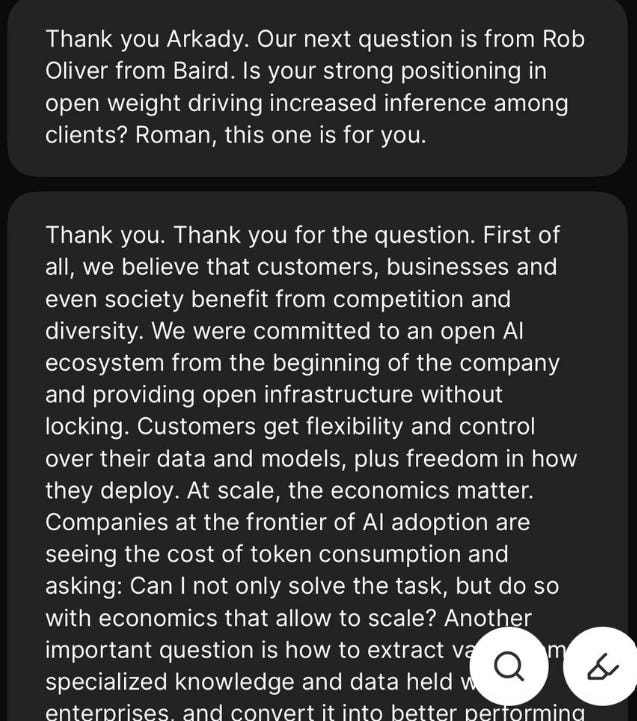
One customer called it the best POC it had ever had, and the discussion is already moving into more capacity, inference, post-training and Vera Rubin.
This is the second part that I think people will underweight. The premium short-term opportunity is not only about making a very high return on spare capacity. It can also be the start of the customer relationship. Nebius can solve the customer’s most urgent problem, prove the platform on one of its most important workloads and then move with that customer into post-training, inference and the next generation of GPUs.
The four large wins this quarter were all competitive. Every customer already had an existing supplier, in some cases a hyperscaler, and Nebius still won on scale, performance, reliability, responsiveness and technical support. These were not inbound walk-ins either. They went through multiple engagement cycles and hands-on POCs. One of them told Nebius it was quite literally the best POC it had ever had. (Quoted by nebius tho i take these statements more lightly)
And now Nebius is already talking with several of those customers about post-training and inference, more capacity and Vera Rubin. So the expensive first rental can become a multi-year customer. That is a much more interesting economic model than simply filling spare capacity for a few months.
This is why I do not see short-term capacity as a completely separate business. It can function as the front door to the platform. The customer first comes because timing is critical and Nebius has the cluster available. Nebius then gets to prove its technology during the exact workload that matters most to that customer. If it performs well, the conversation naturally moves from one training sprint into post-training, inference, more regions and the next generation of GPUs.
The quote about the best POC they had ever had is evidence of that. It does not prove every trial becomes a billion-dollar contract, but it shows Nebius is not winning only because it happens to have spare GPUs. The platform, responsiveness, transparency and technical support are part of why the customer stays. That is what can turn one premium transaction into long-term customer value. Locking in that partner in that ecosystem.
Customer diversification is also becoming more strategic
The customer mix also tells you how Nebius is building the company. Reflection, Cohere and the new US AI lab deepen the relationship with AI-native customers and frontier-model demand. The large US quantitative trading firm adds a completely different vertical. And the wider pipeline now spans AI natives, new labs and enterprises, with multiple opportunities above $1 billion.
Those customers do different jobs for Nebius.
Of course, Nebius is not fully diversified yet. These are still very large contracts, so customer concentration remains real. But the mix is moving in the right direction, and more importantly, it is broadening across customers that have different strategic value to the platform.
That diversification also gives Nebius better information. Frontier labs tell the company which training architectures and cluster sizes are needed next. Enterprises show where inference and specialized models can become recurring workloads. A quantitative trading customer adds another type of high-performance demand with completely different timing. The more of those customers Nebius serves, the better it can decide what capacity to build, where to build it and how much of it should remain flexible.
And that is important for revenue growth. The first sale can be compute, but the relationship can broaden into inference through Token Factory, post-training, software and support. Management already said asset-light revenue and those higher-value services should become a larger part of the mix. So the longer-term opportunity is not only more megawatts at a higher ACV. It is more revenue and potentially more margin from every megawatt that sits on the platform.
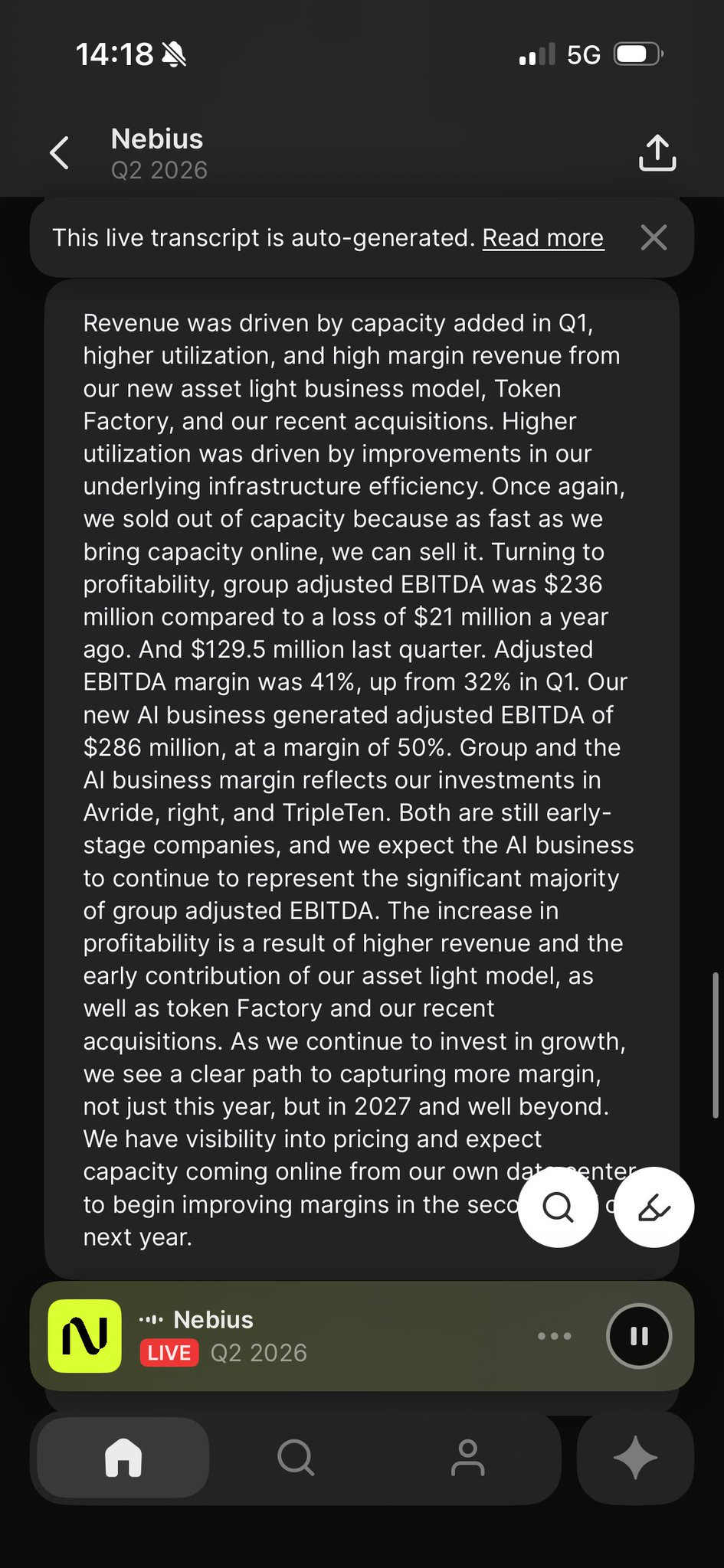
Nebius already points to higher utilization, asset-light capacity and inference services as additional sources of revenue and margin.
Why Nebius is already building for 2027
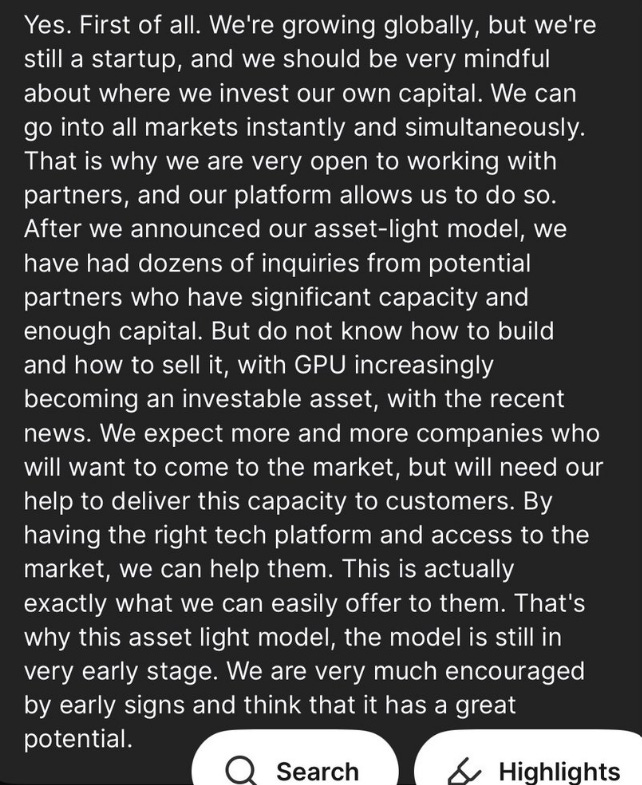
Nebius could already sell its full planned 2027 capacity on current terms, but is deliberately keeping part of it open.
The demand signal for 2027 is therefore much stronger than a normal pipeline statement. Nebius can already sell the planned capacity at $20 million to $25 million per megawatt, the signed deals have an expected payback below two years, the pipeline contains several opportunities above $1 billion, and existing customers are already discussing Vera Rubin capacity.
So Nebius is raising the contracted-power target to 5 GW and wants to deploy more than 1 GW of new capacity per year from 2027.
I think management’s confidence rightfully on 2027 comes from having several demand signals at the same time. The company can already sell the capacity on today’s normal terms. Existing customers are discussing more capacity and Vera Rubin. The pipeline contains several opportunities above $1 billion. The first auction produced a higher market-clearing price. And the short-term training deals show that customers will pay much more when timing matters. One signal can be temporary.
The strategic decision is therefore not simply to build one gigawatt because demand is high today. It is to create several routes for placing that gigawatt when it arrives. Some capacity can go to the contracted base. Some can remain multi-tenant. Some can be sold for a short training sprint. Some can come from a partner instead of Nebius’s own balance sheet. And if pricing keeps moving, the auction gives the company another way to see what the market is actually willing to pay.
That being said, contracted power is not the same as active, revenue-producing capacity. Management explained that after power is connected, it still has to commission the data center, build the clusters, deploy the platform and onboard the customer. That takes several months, which means part of the 800 MW to 1 GW expected by year-end 2026 will only become active throughout the first half of 2027.
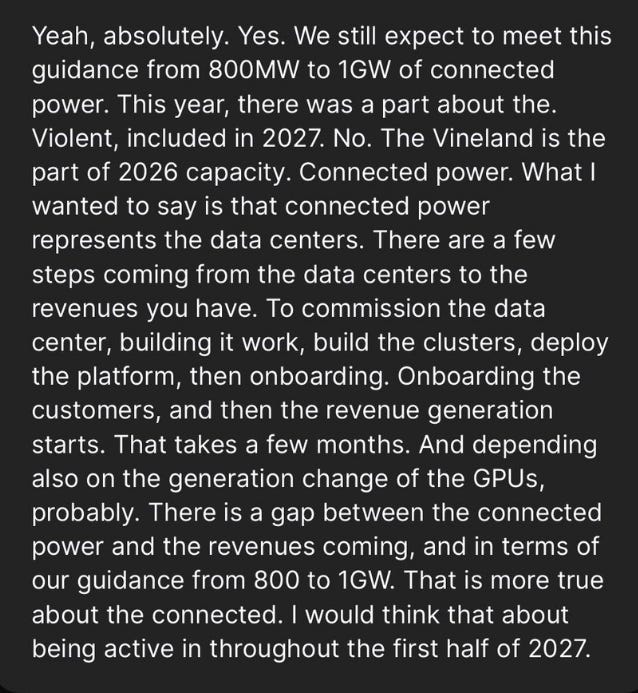
Connected power still needs commissioning, cluster installation, platform deployment and customer onboarding before revenue starts.
So execution is still the part I am watching. The third-party model is early, and I want to see actual partner megawatts, how quickly those sites are deployed, what Nebius earns from them and whether they perform as reliably as owned infrastructure. Same as I also do not expect the $40 million to $50 million pricing to become the normal price across the whole platform. It only needs to remain attractive on the smaller flexible pool.
I am also watching whether the normal ACV really holds around the new level. The move above $20 million per megawatt is very strong, but future contracts will keep moving around it depending on duration, prepayment, customer quality and strategic value. If Nebius can keep the normal deal economics near that level while growing the flexible and asset-light parts on top, then the 2027 opportunity becomes much larger without needing the unrealistic assumption that every gigawatt earns the peak short-term price.
The strategic takeaway
Nebius is not simply building more megawatts. It is building several ways to source, finance and sell the same underlying compute. Long-term customers finance and utilize the base. Mid-term AI cloud contracts build the core business. A smaller flexible pool serves customers that need immediate capacity and are willing to pay a premium. The auction shows Nebius what scarce capacity is worth at that exact moment. And third-party partners can add more supply without Nebius funding every underlying asset itself.
See the way this comes together? Nebius is trying to keep the stability of an infrastructure company while adding the agility of a marketplace. It can serve a frontier lab that needs a critical cluster before launch, charge a high price for that urgent capacity, prove the platform during the customer’s most important workload and potentially keep that customer for years of post-training, inference and future architectures.
If this works, the real advantage will not be bare-metal access or power alone. It will be the ability to take owned, colocated and partner capacity, standardize it through one platform and continuously decide where every part creates the most value. That’s the nebius ecosystem and let me spoil it that can become highly profitable.
That is why I think Nebius executed this strategy really, really well. The company is positioning itself between long construction timelines and very fast-changing AI demand, and it is building the flexibility to make money from both. Now it has to prove that the third-party platform can scale and that the 2027 capacity arrives on time. But strategically, the way Nebius has positioned itself is extremely strong.