
NVIDIA’s Memory Strategy: Why Jensen Huang’s “I Love Constraints” Quote Is Being Misinterpreted
A short article on how to interpret headlines much more accurately and how to realise its impact.

By Markos: I know when Jensen Huang talks, it’s interesting to pull quotes from him..
I have been listening to the man for almost a decade now.
But I’ve seen this quote being misused the past days, so I want to rectify a few things. At the Stanford Graduate School of Business, Jensen was talking about decision making and management philosophy. So he indeed said, “I love constraints. In a world of constraints, you have no choice but to choose the best.”
This quote refers to a management principle inside your company, meaning, for example, when resources are limited. It’s common that organizations waste effort on suboptimal ideas or execution. But when resources are really scarce, like what you’re seeing now in HBM and in memory in general, teams must prioritize the highest impact option.
Again, this is a leadership lesson. It does not reflect at all a supply chain signal as some people on X frame it currently. When you now jump to the comment about the DRAM plants, and is a bit of a curve ball. What Jensen simply was saying is that when Nvidia signals demand to suppliers, it helps them immediately justify their investment, but by any means it’s not a guaranteed demand. As a supplier, you will still compete on the usual metrics that Nvidia holds as criteria: things like qualification, yields, performance, and also pricing.
So again, the Stanford quote was about how you allocate scarce resources as management in a constraint environment. If you look at Nvidia’s actual strategy in the memory supply, you will see the deeper impact of how it works when you are actually the end controller of the market, which Nvidia is.
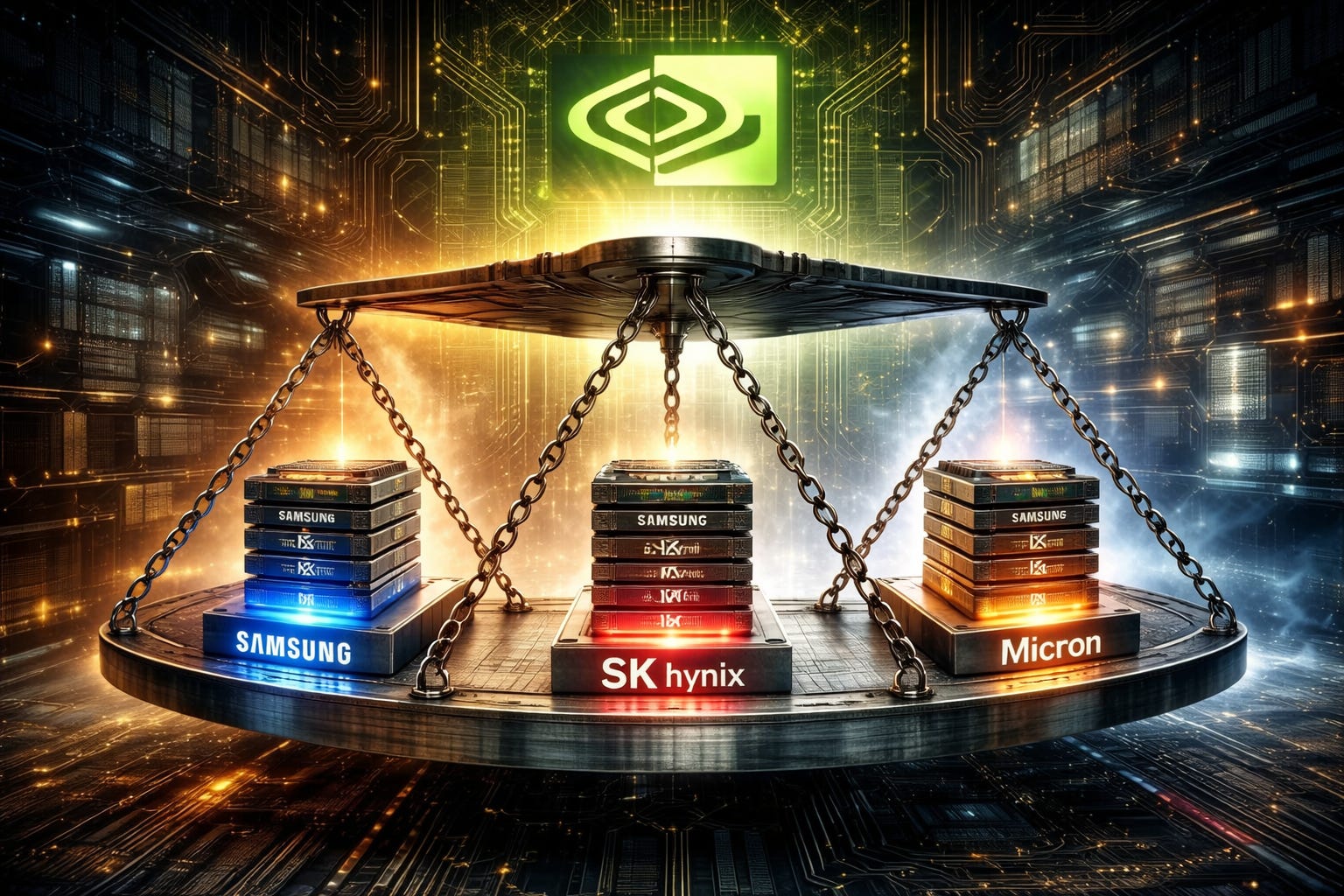
Currently, Nvidia is actively maintaining supplier competition between SK hynix, Samsung Electronics, and Micron Technology. So the phrasing “we choose the best” its about managing resources optimal. When one supplier has a technical lead, Nvidia works to ensure that the others remain viable alternatives. And Jensen pursues this strategy actively, because dependence on a single supplier would give that supplier structural leverage over the Nvidia platform.
This is something that Nvidia wants to stop from happening at all times.
And this is why Nvidia tolerates some temporary leadership, for example by SK hynix, but simultaneously keeps this type of language up to other vendors in the race.
This is why it’s key to deeply understand certain phrases that are used by leaders like Jensen and place them in the right context.
You also need to actively watch management strategies, because this helps certain headlines to be placed in the right order.
For example, when you now see a headline that Micron or SK hynix has the best tested HBM4 for example people immediately think about huge market share gains or massive volume ramps.
If you understand the deeper strategy better, you know how to place these headlines much more accurately and you realize the impact is often much smaller than the headline implies.
Great writeup and context!
Loved this article